The third component of the POW protocol. Learn simple and easy mobilizations to mitigate the compromising positions of daily tasks and sedentary work environments.
Mobility
Good mobility has three components:
- Proper positioning: be in a good position as much as possible. This includes having a braced-neutral spine, torque at the hips and shoulders, proper footwear, and proper workstation set-up.
- Joint range of motion: put your joints through full ranges of motion as much as possible. Squat all the way down, move your ankles, wrists, neck, and shoulders through their full range daily. Apply the addedge, “If you don’t move/use it, you lose it.”
- Soft tissue quality: if you are unable to move joints through a full range of motion, or already have pain, you must address your soft tissue quality. Massage, self-myofascial release (SMR)/foam rolling helps to restore suppleness to muscles and tendons. Always release above or below an area of pain. For example, if your knees hurt, SMR your shins, feet, or quads. To mobilize a joint system, SMR locally.
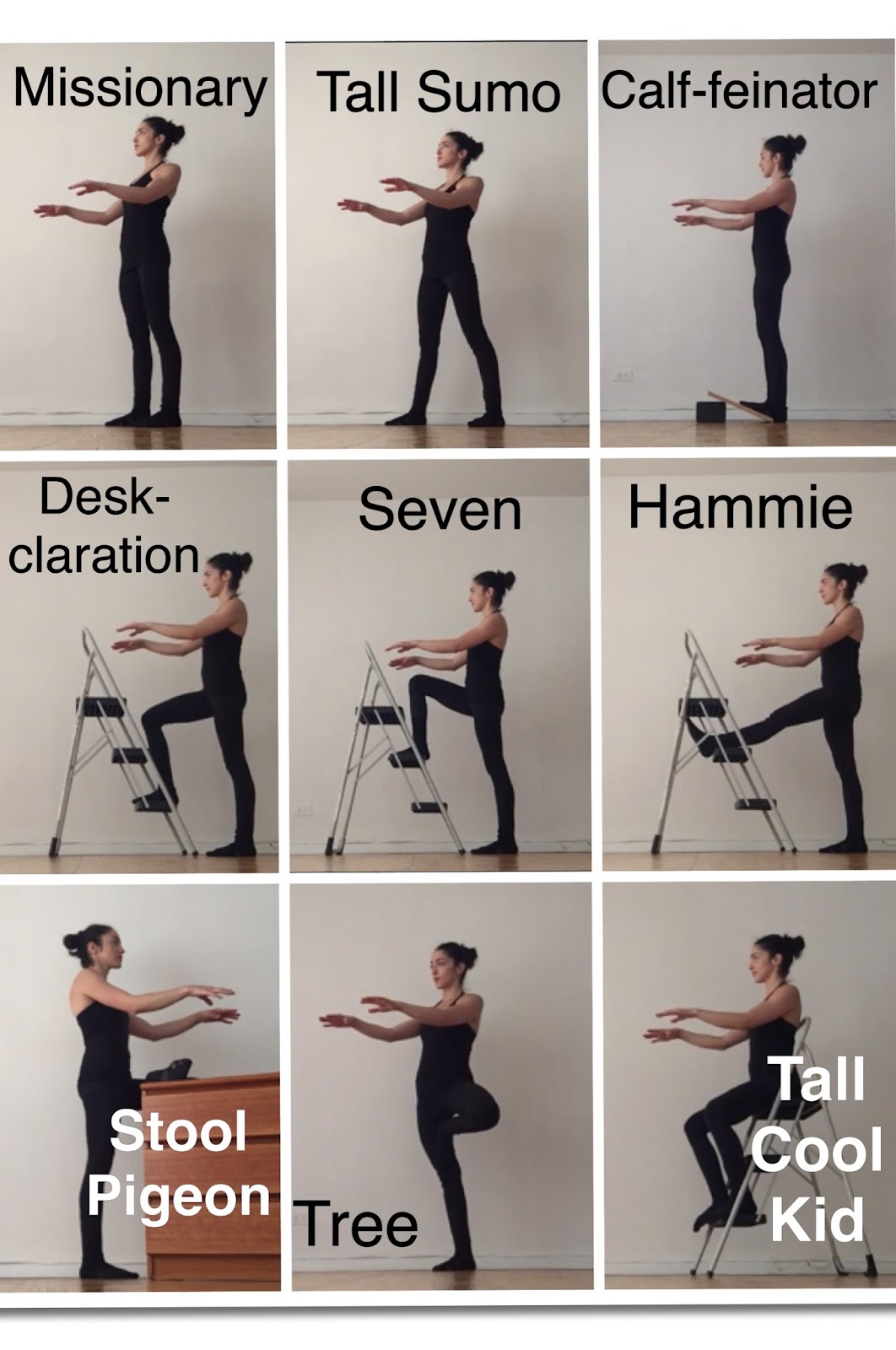
We’ve covered component 1, proper positioning. Here are component 2, joint-range-of motion exercises you should perform each day:

Above: “Heads will Roll” 1-6: Slowly bring head and neck through a full rotation in each direction, several times.

Above: “Clock Arms.” 1-9: Bring each shoulder/arm through a full revolution, both directions, several times.

1&2: Make fists and circle your wrists. 3: Spread your fingers and make big, exaggerated wrist circles. 4: Interlace your fingers and flip your palms. 5&6: Bend your wrists forward, and back, palm-to-palm, and knuckle-to-knuckle. 7: Orient your palm facing out, fingertips down, pull up on thumb with opposite hand.

1&2: Make a ‘4’ with your legs. First, simultaneously pull up on your foot and push your knee away. Next, cradle your top leg, and try to pull it up towards your chest while maintaining a 90 degree hip and knee angle. 3: Grab onto a chair, desk, or wall, pull chest down and push hips back. You should feel a stretch by your armpits, in your glutes, hamstrings, and calves. 4&5: First, stand in a tall lunge, scoop abs in, squeeze your butt. You should feel a stretch in your hip and quad (on the side of your back leg). To intensify the stretch, bend the back knee.
The following mobility techniques are to improve soft tissue quality and help your joints go through more complete ranges of motion. If you have pain or immobility, use these techniques above or below the area of concern. For example, if you have knee pain, use a joint-range-of-motion exercise to open up your hip, and a soft-tissue technique to work on your ankles and lower leg.
These techniques require a lacrosse or mobility ball. Find a sensitive area above or below the area of concern. Apply pressure with your mobily tool. Oscillate joint back and forth to move muscles and tendons under the tool. The duration of these techniques is as long (or as soon) as it takes to feel or see a change in your mobility or pain. If performing these techniques for maintenance, one minute per area should suffice.

Start with your mobility tool slightly in front of your heel, and work through your arch. Flex and point your toes and ankle as you go.

Start with your mobility tool at the top of your tibialis muscle (the tendinous area behind your shin bone, in front of your calf). Flex and point your ankle as you work your mobility tool down your lower leg.

Place your mobility tool on your medial glute area (the fleshy area between your sacrum and your hip bone). Bend and straighten your hip and knee, and make tiny hip circles.