Monday, January 25, 2016

Goalmodel

Gooooooaaaaaaaal!
Do you have a health or fitness goal?  How long have you had this goal?  How many times have you tried to achieve it?  I find that many people have lifelong health and fitness goals.  These goals become an eyesore, lingering around, inspiring feelings of guilt, never being achieved.  It is my job to help people achieve their health and fitness goals, I have a lot of experience in the goal-granting department.  There are two main reasons goals go unrealized 1) they are too obscure, 2) the goalie (person with the goal) does not know or understand how to get what they want.  In a world full of media buzzwords, crash diets and far-fetched workout plans no one knows what they really want or the right way to go about getting it.  I have broken down the most common goals, what they really mean and how to achieve them. 

'I want to slim down and tone up'
I want to lose fat and build muscle
You must eat in a calorie deficit with adequate protein, you must lift moderately heavy weights at least 2 times per week.  You should stand and walk as much as possible.

'I want to gain lean mass'
I want to gain mass, most of it being muscle
You must eat in a calorie surplus, you must strength train with moderately heavy weights at least 2 times per week.

'I want to get stronger / be pain-free / more mobile / work on balance'
I want to feel better and get stronger
You must eat adequate protein and calories for recovery, you must strength train with moderately heavy weights at least 2 times a week.  You should minimize sitting and mobilize positions and joints that are restricted before or after exercising.

'I want to work on my core'
I want defined abdominals
You must eat in a calorie deficit with adequate protein and a good macro/micronutrient profile, you must lift moderately heavy weights at least 3 times per week.  You must should stand and walk as much as possible.
I have had back pain and need to get stronger
You must eat adequate protein and calories for recovery, you must strength train with moderately heavy weights at least two times a week.  You should minimize sitting and mobilize positions and joints that are restricted before or after exercising.

Forest for the Trees
I have simplified your goal into the barebones criteria you need to achieve it.  Yes, there are nuances like rep ranges, macro and micro nutrients (see entry 8:00), supplements and recovery (see entry So Meta or 4 Burners) that I have not covered here.  I left these components out because people tend to get wrapped up in the fine print.  I guess the information above is not flashy enough for most to believe.  If you are a repeat goalie, I am speaking to you.  These details don't matter or have any context if you don't have a grasp on the most important components of your goal.  Don't worry about nutrient timing when you don't know what a nutrient is, don't worry about rep ranges when you don't know how to squat.  If you get started on these principles, you will see progress for quite a while.  You progress will slow down after many months, it is at this point that you can start fine-tuning and learning more details about your specific goal.  If you do not understand how to strength train or lift weights, I suggest you get a strength coach, knowledgeable trainer or read Becoming a Supple Leopard by Kelly Starrett.


Thursday, January 21, 2016

8:00

Nutrient Timing means what to eat when, especially pertaining to your workout.  Nutrient timing has its own timing too.  You should worry about nutrient timing at the time in your life when you have mastered your food quality and quantity.  You must understand the principles of getting nutrients from your food, portion sizes and meal composition for your goals before you even think about nutrient timing.  I will explain all of these concepts and strategies so that by the end of this article you"ll have gone from a nutrient crawler to a nutrient sprinter (and you'll know what and when to eat after your sprint).

Meet your Macronutrients 
These are nutrients that the body needs in large quantities.  Below are the most nutrient dense sources for protein, fats and carbohydrates.  This means that you should get your macronutrients from these sources first.  Doing so will prevent micronutrient (nutrients that your body needs in small quantities) deficiencies.  For example, if you get all your carbohydrates from white bread instead of vegetables, you'll miss out on a lot of vitamins and minerals.  These vitamins and minerals will help all of your systems functions properly.

Protein: 
Proteins contain amino acids which are lost from the body each day.  Essential amino acids cannot be made by the body and must be consumed.  Animal sources have the highest amount of essential amino acids per unit of food.  Protein can absolutely be acquired from plant sources, especially if the sources are varied.

  • Lean meat (beef, chicken, turkey)
  • Fish (tuna, salmon, bass)
  • Eggs
  • Dairy (greek yogurt, cottage cheese)
  • Vegetarian options (peas, legumes, tofu, tempeh)
  • Protein Supplements (based with: whey, casein, hemp, pea)
Fats:
You need a third each of polyunsaturated, monounsaturated and saturated fats in your diet. Getting this ratio out of balance can cause problems.  Since saturated fats are most abundant in the western diet, they are most likely to skew this balance.  Saturated fats aren't bad by themselves, they are crucial for the body, for hormone regulation and a myriad of other reactions.  Do not limit saturated fats, simply keep them in check with your other fats.
  • Saturated (animal fats, coconut and palm oil)
  • Polyunsaturated (macadamias, pecans, cashews, almonds, pistachios, sesame seeds, pumpkin seeds, hazelnuts, olive/oil)
  • Monounsaturated (fish oil, hemp seed, algae, flax seed, sunflower seeds, safflower oil, canola, soy, walnuts, chia seeds, Brazil nuts)
Carbohydrates:
Most of your carbohydrates should come from vegetables, yes, vegetables are carbohydrates.  Vegetables (and some fruits) are high in fiber and micronutrients, making them satiating and nutritious.  Next, look to minimally, processed starchy carbohydrates.  Only eat sugary, processed sugars sparingly if you are an athlete or trying to gain weight.
  • Vegetables (spinach, broccoli, cauliflower, brussel sprouts, cabbage, kale, carrots)
  • Fruits (tomatoes, oranges, berries, apples)
  • Starchy, minimally processed (Potatoes, oats, quinoa, rice, amaranth, buckwheat)
  • Sugary, processed (sports drinks, juice, sugar, desserts, bagels, muffins, some cereals)
Fist Palm
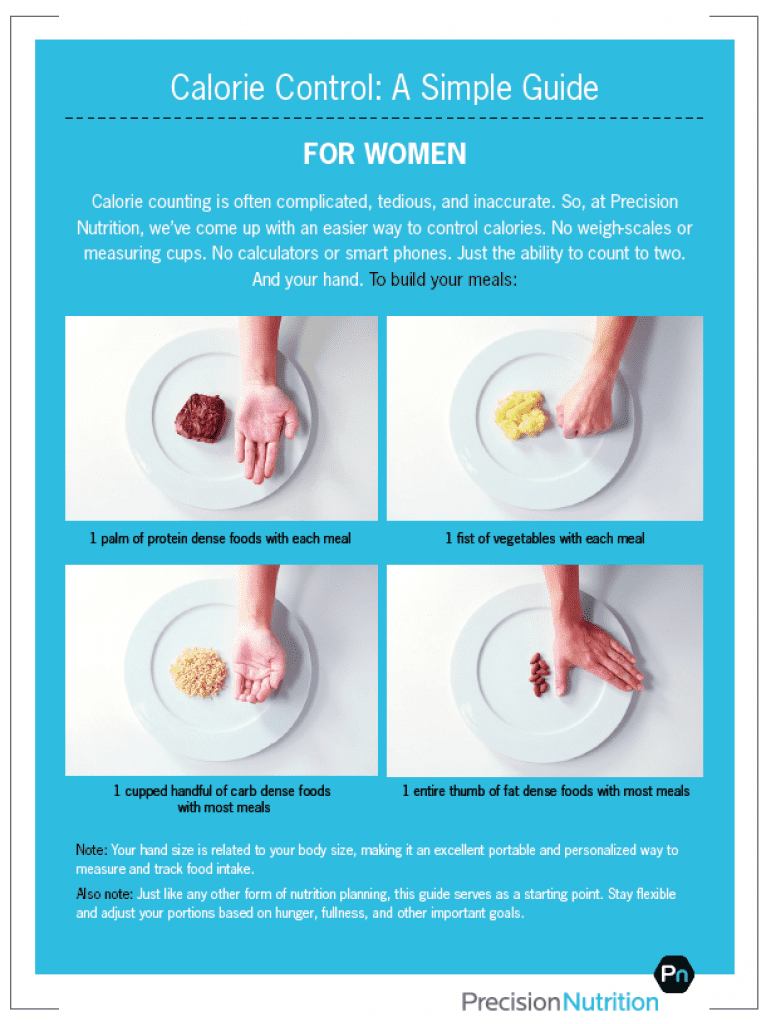
Now that you understand what macronutrients are, you must understand what a serving size of each looks like. You can use your hand to determine portion sizes at each meal.  Let's assume you're eating 4 meals a day.  Each meal should look something like this:
*Plant based people, please, imagine that protein photo is a plant based protein of your choice*
image copyright Precision Nutrition


Your Body, Your Plate
Your body type and goals will determine how much you vary portion sizes and quantities of each type of food.  If you have difficulty staying lean, you may want to cut back on your starchy carbohydrates (because of the insulin reaction they trigger) and fats (because they are most calorie dense).  Conversely, if you have difficulty gaining mass, up your starchy carbohydrates and fats by 1/2 a serving. Here is another fantastic infographic from Precision Nutrition:


Almost ready for take-off
At this point you should understand:
  • What a macronutrient is 
  • The most nutrient dense food sources for each macronutrient
  • What a portion size of food from each macronutrient category should look like
  • How to tailor portion sizes and macronutrient ratios for your goals and body type
This information is more than enough to insure that your health and fitness needs will be met by your diet.  If this information is new to you, I suggest that you apply it for a few weeks before learning about nutrient timing.  For all you nutrition buffs/athletes/advanced exercisers/those dying to know more, read on...

What time is it?
It's nutrient timing time!  There are many theories and practices in the world of workout nutrition.  Overall, it is more important what you eat in a day than when you eat it.  If you get in all your nutrients and monitor your portions each day, your workouts and goals will thrive.  
Macronutrients trigger certain hormonal and systematic reactions that can have a positive effect on your training.  My recommendations on when you consume certain macronutrients are based upon these (extremely over-simplified) reactions: 

  • Protein: contains essential amino acids which are the building blocks needed to repair and grow muscle.  After muscle damage (exercise) the body will look for building blocks to begin its repair and re-growth.  Your body doesn't 'want' you to have more muscle (and less fat) unless conditions are ideal and building blocks are in abundance.  Protein also triggers a series of hormonal reactions which are associated with muscle growth and muscle sparing.
  • Fat: slows down the entry rate of sugars into the bloodstream, triggers hormones to signal fullness and control inflammation.
  • Carbohydrates: trigger insulin, the most anabolic (growth promoting) hormone in the body.  Carbohydrates send messages to cells to 'open up' and get ready to accept and store nutrients. 
I have created a chart based off these reactions and qualities:

As you can see, many recommendations are the same or similar across different body types and goals.  The main principles carried through are:
  • Eat the highest amount of carbohydrates after or during your workout.  This will trigger an insulin response which will open your cells to the incoming protein, which you should also be consuming.
  • Eat fats and protein before your workout if you fat loss or body composition maintenance is a goal.  This will trigger your body to burn fats in your workout.  You don't want to 'top off' glycogen (carbohydrate) stores because your body will burn through those before it burns fat.
  • Supplement with amino acid or BCAA drinks if protein is not abundant.  These will supply your body with the building blocks it needs without making you feel overly full during your workout.  I like the product Amino Boost by Dotfit.
  • Drinks that are a 2:1 carbohydrate to protein ratio may be consumed to improve sports performance and muscle gain.  An example of this would be protein powder and dextrose or protein and a small piece of fruit.
  • Drinks that are 2:1 protein to carbohydrate may be consumed if fat loss or muscle sparing is a goal.
  • Do what you practice.  If you like to workout on a full or empty stomach, do what works for you.  As long as you eat 1-2 hours before and after your workout, your body will get the nutrients that it needs.  
Bait
Okay, I lured you into this post.  I dangled the delicious carrot (cake) of nutrient timing in front of you only to lead you down a long path of plain ole' nutrients.  I did this in your best interest.  Nutrient timing is a highly debated subject.  Some would flat-out disagree with my recommendations, and they'd be semi-right.  This is because if something works, it works.  These are the recommendations that make sense for me and have worked for my clients.  These guidelines work for my clients because prior to discussing them, I teach my clients about macronutrients and portions, just like I did here.  I believe that nutrient timing works for people who have to educate themselves about nutrition in order to apply its principles. 
 If you apply the information in the beginning of this post, it will really change how you look and feel.  The nutrient timing information at the bottom is just icing on the cake (if you're going to have a piece, do so after you workout).


Thursday, January 14, 2016

The Camel's Back

Eternal victim in the face of pain
Here you are, an innocent, virginal creature, minding your business, when, wham, you are saddled with an achy joint or spasmy muscle.  This is a toxic viewpoint, one that keeps you in pain.  I will explain how pain is caused by you, preventable by you and treatable by you.  
*The following pertains to musculoskeletal pain.  I will not be addressing pain as it relates to disease (cancer, etc), catastrophic injury (broken bones, etc) or emotions (lost love, etc).

Pain is a lagging indicator
If you have pain, you have been messing up for a while.  Pain is your body's last ditch effort to get you to be in a better position or change your movement patterning.  Our bodies are meant to go through millions of repetitions of movement and countless hours in positions throughout our lifespan.  Our joints and muscles are supposed to last over 100 years before starting to deteriorate. We expedite this deterioration with negative lifestyle choices such as: sub-par nutrition, not enough sleep, lack of exercise, poor movement quality and being in crummy positions all day long.
Pain can be prevented by understanding its two main causes: repeatedly being in a position that encourages poor spinal organization, repeatedly performing a movement with lack of mobility or stability in a joint system.

The Core of the Matter
What is the core?  No, it's not your abs, not your obliques, not your back (because the back is one muscle, right).  The core is composed of every muscle that works to keep your spine in a braced and neutral position.  Many people spend hours in an over-flexed (rounded) or over-extended (arched) spinal position.  This becomes their default position of spinal stability.
The body will put up with this faulty position of stability for ages until one day, it doesn't.  The final straw could be a bad deadlift in the gym or picking up a pencil incorrectly.  It isn't the final straw activity that causes pain (a back spasm in this example), it's the thousands of bad lifestyle and activity repetitions that accumulated prior.  Many people will associate their pain with the final straw activity, vowing never to pick up a pencil or barbell again.
This line of thinking is toxic viewpoint #2, it never address the underlying postural issue and therefore never addresses the root of the pain.  If you learn how to brace your spine and be in a good spinal position, you can prevent back related injuries for life.  In this video, David O' Connor explains Kelly Starrett's bracing sequence for the spine.

The knee bone's connected to the...
Each joint system (group of muscles and joints that work together) in our body provides us mobility (the ability to move through a range of motion) or stability (the ability to maintain a position).  These qualities alternate with each system, looking like this:
Foot - Stability
Ankle - Mobility
Knee - Stability
Hip - Mobility
Lumbar Spine - Stability
Thoracic Spine - Mobility
Scapula - Stability
Glenohumeral Joint - Mobility
and so on...
When you lack mobility in a mobile joint system, the stable joint system(s) above or below it will become more mobile to compensate; the inverse happens if you lack stability at a stable joint system.     Herein lies the foundation for toxic view point #3 on pain: Pain is often directly correlated to the body part that is hurting (i.e. knee pain equals crappy knees).
Pain is often referred.  For example, a runner (Jane)  thinks her knees hurt all of a sudden because she's getting old and has 'bad knees.'  In actuality, Jane has been running improperly for years.  Over time, her shins and calves shunt mobility from her ankles, her hamstrings and quads become stiff,  limiting hip mobility.  These compensations, lack of mobility and influx of gamy muscle begin to pull on Jane's knee and cause her pain.
Jane will go to doctors, therapists and surgeons trying to fix her knee.  Jane's knee will not get better because her knee is not what is causing her pain.  Jane's running form and maladjusted tissues are the culprits.  If Jane works on improving her form and mobilizing her gummed up tissues, her knee pain will subside.

Roll out
To review, the top three ways to prevent pain: have a good default spinal position, do not sacrifice quality for quantity in terms of movement,  have optimal mobility/stability in each joint system.  Now, what to do if you already have pain?  Let's say you have knee pain.  You are going to have to look above and below your knee for poor tissue quality and trigger points.  Your muscles should feel lithe and supple to the touch.  If you come across an area on your quad, for example, that feels rigid or sensitive to the touch, you can try rolling (self massaging/releasing) this area out with a lacrosse ball or mobility tool of your choice.  I recommend using Yoga Tune Up balls or Mobility WOD tools as an upgrade on the lacrosse ball. Kelly Starrett's YouTube has hundreds of videos on how to 'roll out'/mobilize your tissues, improve your ROM, resolve pain and immobility.  A lot of information in this entry is derived from his book: Becoming a Supple Leopard.  Learning how to perform self myofascial release (SMR) is extremely valuable.  If you understand how to restore tissue quality and mobility in your body, you will be able to remedy pain and make movement feel good again.

Detective time
Before you run out and buy a lacrosse ball you must also figure out what is causing you pain.  Riffle through your daily activities, ask yourself what you do a lot of and what movements might be causing you pain or what faulty positions you are in.   Movements don't cause pain when done properly, you make them hurt by doing them wrong.  The solution may be getting a standing desk if you can't seem to sit in a braced position, or getting a running coach if you never learned how to run correctly.  You must address the underlying root of your pain in addition to restoring tissue quality to make it go away for good.
How you sleep is very low on the list of positions that cause pain.  Pain is often felt most in the morning so it can be associated with sleep.  Inflammation is highest at night, it is part of the healing process and can have some residual presence in the a.m.  Also, pain is not sensed as well during movement, its nerve signals come in clear with the stillness of sleep.
Sometimes a lack of strength and stability is to blame for pain.  If you can get into positions easily but cannot hold yourself in them or find it hard to get out of them, this may be the case.  For example, if you can get into a squat easily but cannot stand up out of it you  need to get stronger and more stable.  'Tight' muscles are not strong, they are overworked and doing the wrong job.

Healthcare
You are your best healthcare provider.  It is your responsibility to care for your health and prevent disease in your muscles and joints.  Take responsibility in the face of your pain, understand proper positioning and movement as it pertains to your lifestyle.  Know how to restore tissue quality and range of motion in your body.  Prioritize quality of movement over time, distance or weight.  Go from being a victim to being a hero.


Monday, January 11, 2016

So Meta

 The enigma of the metabolism
 Many perceive the metabolism to be much like a spirit that inhabits the young body and then decides to vanish into the ethos as we age.  Many believe certain things will make this spirit stick around longer, like eating every 30 minutes, and praying.  Parallel with these beliefs is the idea that one can boost or vanquish their metabolism with one wonderful or terrible decision.  I am here to throw a sheet over this metabolism poltergeist.

Metabolism is the sum of reactions that take place to build up and break down the body.  Metabolism happens on a cellular level, which is why it seems so far out of our control, how can we control trillions of tiny cells?  Some aspects of metabolism are more auto-regulated than others, yet our actions do affect our metabolism.  Understanding these actions and the pieces that make up metabolism will put us back in the driver's seat.  Metabolism can be broken down into 5 components: Basal Metabolic Rate, Resting Metabolic Rate, Thermic Effect of Feeding, Exercise Activity, Non-Exercise Activity Thermogenesis.   

Basal Metabolic Rate
BMR is the minimum level of energy expenditure needed to maintain vital functions in the body.  This means the minimum amount of calories needed to keep us alive in a fasted state.  Think of BMR as your baseline metabolism.  Here goes a typical body-as-house metaphor: BMR is the electricity bill when you first get a new house.  The lights haven't been used, but you have enough electricity to use them.  BMR doesn't include your gas bill (digesting food).  
70% of the calories we burn on a daily basis are used for BMR, to keep our vital functions functioning.  This is is the part of metabolism that we have the least control over.  Not to fear, the other 30(ish)% of daily metabolism is highly variable and within our control.

Resting Metabolic Rate
RMR is very similar to BMR.  It is The amount of calories needed to sustain the vital functions at rest.  In layman's terms, RMR is BMR with more lax testing standards.  RMR is usually only 10% higher than BMR.  Testing for BMR requires the test subject to be in a fasted state and sleep 8 hours in a temperature regulated room (my mom would be a great candidate, hi mom).  RMR test subjects are allowed to eat and move, but not perform strenuous activities.  RMR formulas are based off an organism's lean body mass.  LBM (think muscle) is more metabolically active than fat, meaning it burns more calories at rest than fat.  This is why strength training is important, if you have more muscle, you will burn more calories at rest.

Thermic Effect of Feeding
TEF is the amount of calories needed to digest food and distribute nutrients into the blood.  This is where the 'eating more frequently boosts metabolism' idea comes from.  Eating food does burn calories, but not enough calories to cancel out the food you have just eaten.  When you don't eat, your body will not be using calories to digest food, and when you do eat, it will.  So, yes, your metabolism is lower without TEF, but so is the amount of calories you have taken in.  The second you eat, TEF gets kicked into gear.  Eating more frequently isn't like a fire that keeps your metabolism going, it is like a fire that burns the kindling you need to light it with.  Proteins require the most energy to break them down, and fats need the least.  TEF accounts for about 10% of daily metabolism.

Exercise Activity
The calories burned to perform exercise are a highly variable component of daily energy expenditure. Exercise activity can account for 10-30% of daily metabolism depending on an individual's activity level.  The more strenuous the exercise, the higher its metabolic demand.  When an individual does steady state cardio (like running or cycling), the metabolic demand will only occur during the period of exercise.  Strength and power training (weightlifting, lifting weights) creates such a high metabolic demand that the body has to play 'catch up' and remains in a metabolically elevated state after the exercise is completed.

Non-Exercise Activity Thermogenesis
NEAT is unplanned, low intensity physical activity that takes place every day.  NEAT includes walking, pacing, doing chores, fidgeting, etc.  NEAT is a very important component of metabolism. NEAT happens almost automatically, yet its effects are undoubtedly noticed.  

When an individual (let's call him Bob) undereats his body will adjust by decreasing his NEAT. Maybe Bob used to fidget and pace; now underfed, this extra movement will cease.  When Bob goes back to eating regularly, he will subconsciously be in the habit of conserving energy. With NEAT accounting for fewer calories than he is now taking in, Bob will be an example of someone who thinks he ruined his metabolism on a crash diet.

Conversely, I have many clients who increase their NEAT by walking a bit more each day. This may mean getting out of the train one stop early, pacing or standing at work.  This seemingly nominal amount of activity pays off in divedens. One can boost their daily metabolism by a few hundred calories by increasing NEAT.  NEAT is really neat, anyone can do it quite painlessly and it really does aid fat loss. I do not have one client who it has not helped.

Ghost busted?
Metabolism is an ever-changing, open ended process responsible for keeping us running and keeping us from running on empty.

Here are the top ways to 'boost' your metabolism:
• Increase your lean mass. Lean tissue burns more calories than fat. The majority of age related 'metabolic decline' is based on muscle loss.
• Eat about every 3 hours
• Eat protein with every meal
• Strength train at least 3x per week
• Increase NEAT!

Know that you have almost total control over your metabolism. You aren't stuck with a slow metabolism, it is your lifestyle choices that are slowing it down.


Sunday, January 10, 2016

Fallen Arch (Angel)


Do your feet hurt? 
Don't worry, this isn't the beginning of an infomercial.  I am here to turn what you know about feet all around (on its head, if you will).

Fallen Arches
A fallen arch is basically the weakened state of the muscles and ligaments in your feet.  Most children have healthy, archie arches.  These arches flatten out when an individual starts wearing supportive or inflexible shoes.  That's right, flat feet are caused by supportive shoes and insoles.  Arches (geometrically and anatomically) get stronger when they are top loaded and weaker when they are bottom loaded.  This means that putting weight (your body) on top of an unsupported arch will make it stronger while 'supporting' your arch will make it weaker.
The best way to get your arches back is to get rid of your insoles and work towards wearing minimally supportive shoes.  You can work your way down since going from very supportive shoes to minimally supportive shoes can cause muscular pain (those arches working and getting stronger) if done too hastily.
Recommended shoes to work towards: Reebok Nano, Nike Metcon, VivoBarefoot, Inov-8, some styles of Converse/Vans/TOMS/Keds, Feiyue.

Heel Cups from Hell
For my runners, please do not heel strike.  Many running shoes have a very supportive and cushy heel.  Some brainiac decided that runners should have longer strides and should therefore strike the ground with their heels.  Stride length doesn't make one a faster runner, shin/tibia length and whip is what does.  Striking with your heel, as opposed to midfoot, will cause a lot of impact since the calcaneus (heel) as no shock absorbers.  Also, heel striking will put you in a constant state of dorsiflexion (flexing your foot), leading to tight tibia muscles, knee pain, the whole shabang.
I suggest reading up on POSE running, a system of proper running technique developed by Dr. Nicholas Romanov.  I also suggest checking out the brands Saucony, Brooks, Newton and New Balance Minimus for sneakers without heel cups.
If you already have achy knees/feet/shins from poor running form, roll out your shins with a lacrosse ball.
Kelly Starrett has a fantastic video on mobilizing the lower leg.

Plantar starts with an 'F'
Plantar Fasciitis can be extremely painful and scary, yet it is surprisingly easy to remedy.  PF manifests as stabbing foot pain often worse in the morning.  I have had numerous clients and a relative go to specialists for help with this issue.  These specialists recommended insoles and rest.  Insoles and rest are the exact opposite cures for PF.  If you are suffering from tight plantar (sole of the foot) fascia (connective tissue) here is what you should do:

  • Buy a super bouncy ball and massage the sole of your foot with it.
  • Wear shoes that are snug, flexible and minimally soled
  • Do not wear flip flops or shoes that you have to grip with your toes to keep on
  • Do not wear overly supportive or inflexible shoes
  • Sleep with your feet hanging off the edge of the bed (the plantar fascia gets 'tight' when the ankle is in dorsiflexion, this will put you in slight plantar flexion).
  • Make sure you articulate through your foot when you walk or exercise.
I know some or all of this information may seem counterintuitive.  There is a culturally accepted idea that we have to protect and swaddle our bodies and our feet.  It seems that a cushier, more supportive shoe would protect us and make our feet happy, yes?  No.  Actually, the more supportive your shoe, the harder you will strike the ground with your foot.  Your foot wants to feel the ground, it will keep putting more impact through the sole of your moon shoe until it gets what it wants.  The more you can feel the ground, the lighter your step will become, and the happier your feet will be.  

Friday, January 8, 2016

4 Burners

In order to lower your body fat you will need to modify these 4 things: Nutrition, Non-Exercise Activity, Strength Training, Recovery.

Nutrition:
You need to know what you are eating.  Keep a food journal, written or use the app MyFitnessPal.  Begin by logging, don't worry about how much you are eating at first.  Seeing what you eat in a day will help you immensely.
After a week or two of solid logging, you can set a daily calorie goal for yourself.  For fat loss, this will mean eating fewer calories than you burn.  To estimate the amount of calories you will need to create this deficit, multiply your weight by 10-12 if you're sedentary, 12-14 if you're moderately active, 14-16 if you are highly active.
Ideally, the bulk of your diet should be foods without labels.  Each meal should be built around a protein source, and your starchiest, most carb heavy meal should be after you workout.
Precision Nutrition has a helpful infographic on portion control:

NEAT:
You need to walk and stand as much as possible.  This stands for "Non-Exercise Activity Thermogenesis," or "lifestyle calories."  These are calories that you burn from walking, standing, doing chores, not sitting on your butt.  NEAT is the component that most directly affects your daily energy balance.  This means if you want to burn a few more hundred calories a day, you should work on standing and walking more, not killing yourself on a spin bike.
Cardio that you enjoy and doesn't hurt you is all well and good, however it isn't necessary for fat loss.  The only time I would recommend 'expedited NEAT' is when someone cannot fit more walking or standing in a certain day.  For example, if you sit in a car for 10 hours, doing some elevated cardio (walking on an incline on the treadmill, climbing stairs) might be warranted to make up for the steps you missed.
Speaking of steps, get a pedometer or use the health app on your iPhone.  Aim for 10,000 steps per day. You can get these steps walking around at home or pacing at your job, you don't have to get them all outside.  

Strength Training:
You need to lift heavy, with good form.  Watching what and how much you eat and increasing your NEAT will help you to lose weight, strength training will help ensure that that weight is fat.  In order to stay strong while in a caloric deficit, you need to force your body to hold onto its muscle mass.  In order to look more defined, you will have to build some new muscle mass.  Just to clarify, all muscle is lean mass, muscle doesn't make a person look 'bulky,'  People who have a very muscular look have worked very hard for this, it won't just happen to you.
Doing high reps with light weights or performing fancy, complicated exercises is not going to cut it, or make you cut. You need to perform exercises with the potential for progressive overload, and increase in the load/intensity over time. Lifting moderately heavy weights will force your body to build and preserve its lean tissue.  The body responds to stimulus and adapts.  Lifting weights provides a big stimulus, your body will adapt to this stimulus in a big way, by favoring your lean tissue.
 Squatting, deadlifting, and pressing are the tried and true weighted exercises that will allow you to lift the most amount of weight.  Pull-ups, Rows, push-ups, dips, and leg lifts are the staples in terms of body weight exercises.  You need to learn the intricacies of how to perform these exercises and then increase their load over time.  I suggest you get a coach, take a CrossFit foundations course or read Kelly Starrett's book Becoming a Supple Leopard to understand the positioning and technique of these movements.
There are many other ways to get your resistance training in.  For example, you can take CrossFit, gymnastics, weightlifting, inversion based yoga, aerial arts classes.  I provided the aforementioned exercises because learning them is the most concise way to strength train. Once you understand how to do them, you will have these simple (yet sometimes slightly complicated to learn) exercises for life, all that will change is the amount of weight that you are lifting.

Recovery:
You need to sleep and have a low level of stress.  Sleep is facilitates fat loss by regulating hormones, hunger signals and helping lean tissue grow and recover.  Make sleep a priority, get on a regular sleep schedule, learn to wind down at the end of the day.  Being stressed will make your body perform like it is in a time of famine and peril. This means it will be reluctant to get rid of its most easily accessible energy source: fat. Nothing is more annoying when you're under pressure than someone telling you to "chill out."  All I will say on the matter of stress is live for yourself, control what you can, don't worry about what you can't.
.
These are the 4 burners on the stove of fat loss and body recomposition.  If you turn down one of these burners, the others will have to be turned up to compensate.  If you ever reach a plateau, picture your burners and ask yourself which one needs to be cranked up a notch.