Monday, March 21, 2016

Pinch an Inch

So, you read my post on the insignificance of weight and are looking for other ways to track your progress.  You've come to the right place.  Mirror checks, selfies, and trying on clothes are fantastic subjective measures to gauge fat loss.  The best objective method is body fat, or body composition testing.  Body fat fluctuates less than weight and reducing it has a stronger positive correlation to aesthetic goals.

Body fat is expressed as a percentage of your weight.  A body fat test will tell you roughly what percentage of your body is fat and what percentage of your body is non-fat or lean mass (organs, muscle, skin, hair, etc).  Your weight is needed to contextualize body fat, body fat is a part, your weight is the whole (but not the whole picture).
For example, if you weigh 150 pounds and have a body fat of 10%, you have approximately 15 pounds of fat.  If you gain 10 pounds, but your body fat goes down to 8%, you will have 12.8 pounds of fat, meaning you lost fat.  Conversely, if you lose 10 pounds and your body fat goes up to 12%, you will have gained 1.8 pounds of fat.
The simplest way to make your body fat go down is to be in a calorie defect or surplus (if your focus is gaining muscle) with adequate protein, and to strength train.  There are more advanced methods including nutrient timing, macronutrient cycling, strength waves, you name it.  Stick to the basics, see how much you can change your body with the smallest defect and simplest strength program possible.  When you stop seeing results, you may need to take your program to the next level.
Most affordable methods of body fat testing won't tell you the exact amount of fat in your body, but they will tell you if your fitness or nutrition plan is working.

Here are the most accepted ways to measure body fat, listed from most accurate to least:

  1. DEXA (Dual Energy X-Ray Absorptiometry) Scan:  X-ray beams of varying intensities pass over the body to measure the density of  fat, bones and lean mass.  This method must take place in a medical facility and costs well over $100.
  2. Hydrostatic Weighing:  The participant gets weighed underwater and on land.  These two weights and the density of the water are plugged into a formula that computes the subject's density or body fat percentage.  This method must take place in a specialized facility and is moderately priced.
  3. Air-Displacement Plethysmography: The subject sits in a small pod that measures how much air is displaced by his/her body.  Like hydrostatic weighing, this value is then used to compute the density of the participant.  This method must take place in a specialized facility and is moderately priced.
  4. Skinfold Calipers: Skin fold tests can be performed using 3, 4, or 7 sites on the body.  The density of fat in these areas is measured by pulling up (or pinching) the fat and measuring its thickness using calipers.  The measured values for each site are added and plugged into an equation that computes body fat percentage.  This method is inexpensive, fairly accurate and accessible to most.  The accuracy of this method is heavily reliant on the proficiency of the person holding the calipers.
  5. Bioelectrical impedance:  Special scales or handheld devices send tiny electrical impulses through the body.  The speed at which these impulses return to the device is used to determine the leanness of the subject.  This method is attainable to almost anyone, but results are highly variable and sometimes unreliable.  A set time, hydration and feeding protocol should be used with these devices since fluid in the body can skew results.
Skinfold caliper readings are my chosen method of measuring body fat, I use a 3-point test with my clients.  I am partial to the 3-point method only because I am most accurate at administering it.  I've had a DEXA scan (the most accurate method) once, and my results were in between results for 3-point and 4-point skinfold tests.

Whatever method you choose, here are a few guidelines for testing:
  • Do not test more often than every 2 weeks.  Results cannot be discerned in very short periods of time.
  • Test even if you think your percentage went up, it is important to understand why and make changes.
  • Test at the same time of day, with the same technician, if possible.  Your technician or method may be inaccurate, but as long as they are consistent, you can still track results.  For example, if your method is 5% off every time, you can still see if your body fat is going up or down.
  • Have other data, such as a food or exercise log, to correlate results with.
  • Look at the trend of your body fat percentage over time, don't get too caught up in the actual numbers.
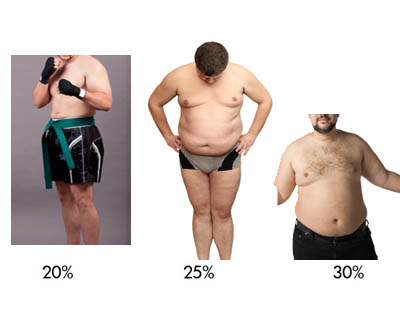
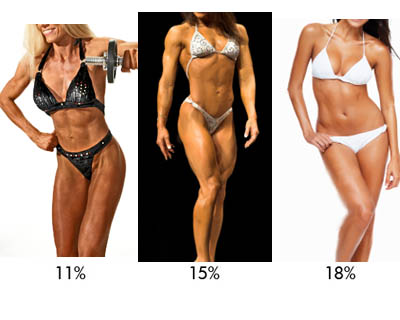
More on that last point:  Knowing your exact body fat percentage is not as important as knowing what make it go up or down.  However, there are certain 'zones' of body fat that will allow you to see changes in your body.  Leigh Peele came up with these really excellent picture of what certain body fat percentages look like on real people:
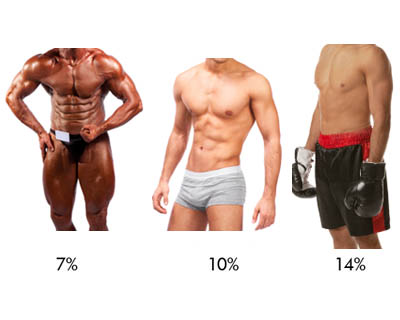
Males at lower ranges of body fat where definition becomes visible.
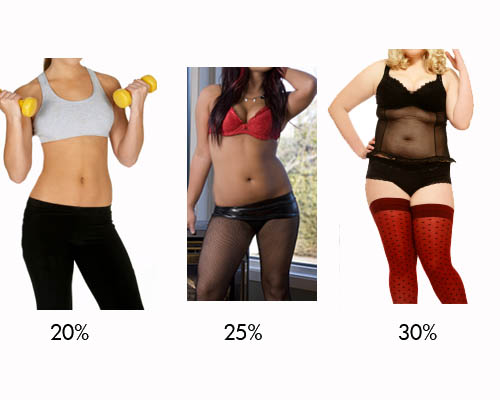
After 30%, measuring body fat becomes difficult and is not a good metric of progress.

Females at lower ranges of body fat where definition becomes visible.

After 30%, measuring body fat becomes difficult and is not a good metric of progress.

These images give a ballpark idea of how each range of body fat will look.  Men and women will really start to see definition at under 15% and 20% respectively.  Men are able to maintain a lower body fat percentage (by about 5%) than women.  Essential fat is 3-5% for men and 8-10% for women.

Where you lose body fat from first is determined by genetics and hormones.  You cannot 'spot reduce' any area on your body by doing specific exercises, but you might be able to alter where you store fat through diet and exercise.  Strength training and eating a diet low in refined carbohydrates will shift your hormonal profile and mobilize fat.  Whether or not you can control where the fat is mobilized is up to debate.  However, loosely subscribing to the idea that you can control your hormones and where you store fat may empower you.  Instead of doing extra crunches to get rid of your stomach fat, you might try lowering the amount of sugar you eat to regulate your insulin response.  This strategy will work to reduce overall fat, even if the fat-hormone connection is bogus.  Here is a simple chart that expands on fat storage and hormone levels:


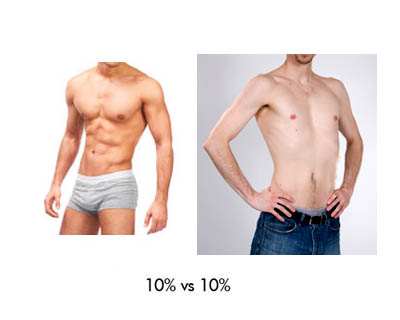
Muscle mass is another huger player in the specifics of how certain body fat percentages will look on certain people.  These pictures illustrate:
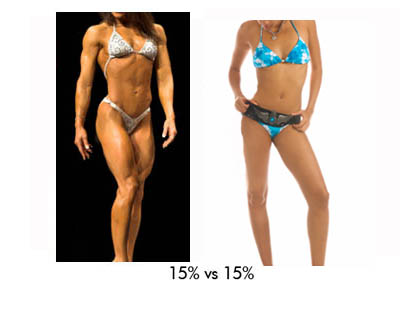
These women have roughly the same body fat.
These men have roughly the same body fat.
As you can see, having more muscle mass and a low body fat percentage will make a person look more defined than simply having a low body fat percentage.  This is one of the reasons weight should be low on your list of concerns.  The person on the left weighs significantly more than the person on the right in both of these photos.

Knowing your body fat percentage is a great tool if you feel like you have a couple of pounds to lose, or if you don't want to change your size, but you want to change your shape.  If you have a lot of weight to lose or gain, weighing yourself might be relevant to your goals.

 In the end, how you feel and how you feel about how you look is most important.  If you're 8% body fat and feel like crap, you might need to hang out around a higher percentage.  Setting body fat goals should not be another case of number chasing, it should be a way to quantify physical and aesthetic goals.  If you realize the body of your dreams exists at a higher or lower percentage than you expected, throw caution to the numbers and go after that dream.


Tuesday, March 8, 2016

Weight Class

Weight is intertwined with notions of fitness.  The scale is not only an icon of justice, it is an image of wellness and a symbol of health.  This is because, unlike justice, weight is easy and objective to measure.  That's all, weight is easy to find out, it is not linear, and it doesn't it measure body composition, strength or aesthetics.  Using weight as your only barometer of success is archaic and unproductive unless your are in a weight class sport.  Before delving into more effective assessments, you must first understand what your weight is comprised of and what affects it.

Skin and Bones
Your weight is made up of the following, in order of hardest to change to easiest:
  • Essential Body Mass--weight of organs, glands, bones, hair, etc.
  • Visceral Fat--fat stored around your organs for protection and hormonal balance, this fat is essential and doesn't fluctuate in non-extreme cases.
  • Subcutaneous Fat--fat stored right under your skin, this is usually the fat lost or gained.
  • Muscle--some muscle is essential for movement and structural integrity, the rest can be hypertrophied or atrophied based upon movement stimulus, protein and calorie levels, stress and more.
  • Water--your body is more than 60% water in weight and volume.  Muscle is 75% water, blood is  92% and fat cells are about 25%.  Water is easy to manipulate in the body, a lot of scale weight lost or gained is water weight.  Most people in weight class sports manipulate the water in their body to change their weight without affecting performance.
Your weight is a snowflake

Each time you weigh yourself, different factors add up to produce the outcome.  No two weights are made of the same components, even in the same person.  The following influence your daily weight and scale fluctuations:
  • Food or waste weight--the weight of how much food or excrement you have in your body.  If you eat a 5 lb sandwich, you now weigh 5 lbs more.  One time a client weighed in 3 lbs lighter after weeks of no change, I asked her what she did differently.  She responded "I wasn't lying to you about what I ate, but I guess I was still full of crap."  You get it.
  • Glycogen storage--carbohydrates are broken down into a molecule called glycogen.  Glycogen is stored in your liver and muscles and accounts for some of their weight.  Every gram of glycogen stored carries 3 grams of water.  If you tap into your stored glycogen through exercise or restricting carbohydrates, you can lose pounds of scale weight.  Conversely, if you eat a whole lot of carbohydrates or don't exercise for a week, your glycogen stores will increase and you will gain weight.  Glycogen is the number one reason you associate short term 'good' or 'bad' behavior with weight loss or gain.
  • Alcohol consumption-- makes your retain water.
  • Fluid Loss--gastrointestinal illness, sweating or the use of diuretics cause fluid (weight) loss.
  • Electrolyte imbalances--not having balanced ratios of sodium, potassium, magnesium and zinc because of diet, illness or exercise make you retain water.  Excessive sodium consumption gets blamed for this phenomenon.  Sodium does have hydrophilic (water binding) properties, it is also the easiest electrolyte to consume in excess.  Any imbalance of electrolytes will make you retain water and temporarily gain weight.
  • Post Exercise or feeding edema--temporary inflammation follows exercise and eating. This is a normal occurrence and affects weight.
  • Hormonal Fluctuations and stress--in addition to cyclical hormonal changes in women and men (yes, men's hormonal levels go through cycles as well), lack of sleep or proper nutrition and increased external and internal stress cause hormones to become imbalanced.  Hormones are regulators, they moderate fluid balance, inflammation, even fat loss.
Note that muscle gain and fat loss are not on this list.  This is because muscle gain and fat loss, the stuff you care about, are not fluctuations.  It takes two weeks minimum to notice a measurable change in fat loss.  Muscle gain takes about four weeks of hard work before a change is perceived.  If you weigh yourself every day you're getting more information about your bowels than you are about your fat.  So, what should you do instead of weighing all the time?

Mirror, mirror
The best ways to measure progress for an aesthetic goal are: be vain and go shopping (in your own closet).  If your goal is to look better or have clothes fit better, look in the mirror, take some selfies and try on your clothes.  If you like the way you are looking and your clothes are fitting better, who cares what your weight is?  Would you rather: have your dream body and be 10 lbs heavier, or look your worst and be 10 lbs lighter?  Sometimes your dream body doesn't always come with the dream weight you expected.  Gaining muscle and losing fat can result in smaller changes in scale weight than flat out losing weight with no increase in lean body mass.

Get pinched
I measure most of my client's body fat with skinfold calipers every two weeks.  Skinfold measurements are the most accurate of the cost effective body fat assessments when done by the same person.  These measurements tell me how well what we are doing is working.  Body fat percentage is an objective measurement that can be supplemental to subjective data like mirror checks or photos.  For example, a client may say, "ah, when my stomach looks the way I want it to, my body fat is 17%, and I have to do X, Y, and Z to maintain it."  Or, if a client is not losing body fat, I will address which of their 4 burners needs to be turned up.
 In order to contextualize body fat, you must be weighed, body fat is measured as a percentage of weight.  If your body fat goes down and weight stays the same, you've still lost fat.  This is a time when the scale is appropriate.
*Note: if you do not have a trusted body fat taker, you may use circumference measurements.  Measure around the smallest part of your waist and fullest part of your hips (butt) to track fat loss.  You may also keep track of the circumference of your chest, arms, thighs, thorax, or neck if these areas are relative to your goal.

How do you feel and how do you do?
Are you feeling better, less out of breath, more mobile and strong?  Are you lifting heavier weights, moving your body in new ways and generating more power?  If so, your athletic performance is improving.  The scale may fluctuate as you gain muscle and lose fat, but you can cherish performance increases forever.  You'll never forget the day you first deadlifted double body weight, or got your first pull-up.  I bet you can't remember the day you weighed x amount of perfect weight at all.

Stop Scale Shaming
The scale is just a tool, sometimes it is useful and necessary.  I have some clients who are very overweight, they get weighed weekly.  I don't care what kind of weight they lose, for a while, they need to lose any weight they can to be healthier.  I do weigh most of my other clients every two weeks, to contextualize their body fat percentage.  In the long run, if you have a fat loss goal, the scale should be moving down, if you want to gain mass, the scale should be moving up.  It's daily weighing that can get you bogged down.  Establish what information you want out of the scale, determine if it can give you that information, and use it for that purpose only.  Once again, don't hate the player (the scale), hate the game (the unproductive ways in which people use scales).


Friday, March 4, 2016

A Sight for Sore Thighs

Everyone who enjoys exercise is slightly masochistic.  C'mon, you know you enjoy feeling 'the burn' during exercise, and isn't there some excitement in making yourself sore the next day?  It's liberating and therapeutic to cause yourself pain, survive and get stronger because of it.  Although, you aren't fully empowered until you understand the mechanisms behind this pleasurable pain.  Why do muscles fatigue or 'burn?'  What causes muscle soreness?  Do you always need to rest sore muscles?  If you answered "lactic acid," and "yes," you need to read this.

Insert Richard Simmons quotation here

Many attribute the burning feeling in their muscles during exercise to lactic acid.  Most have been told something like this: "Lactic acid is a waste product excreted in muscle during anaerobic exercise."  Or: "Lactic acid makes muscles acidic and unable to contract."  This information isn't dead-wrong, but it's not spot-on.
  It is now accepted that muscle fatigue from anaerobic exercise is caused by a lack of fuel to muscles and an increase in muscle and blood acidity due to hydrogen ion byproducts of glucose metabolism.  Here is a very diluted description of what goes down:
  • When exercise is performed without oxygen to generate ATP (the body's currency of energy), sugar metabolism (glycolysis) gets kicked into high gear.
  • Hydrogen ions build up as a by-product of anaerobic glycolysis.  These ions make muscle acidic and reduce its ability to contract.
  •  Pyruvate, another  product of glycolysis, binds to these hydrogen ions to buffer them, from this, lactate is formed.  
  • Lactate is the proper terminology for what is colloquially referred to as lactic acid.  Lactate allows exercise to continue by buffering acid and providing fuel for muscles and the brain.  
It is true that as blood lactate levels rise, exercise performance decreases, this is a case of correlation, not causation.  Trained athletes benefit from  lower blood lactate levels during exercise because this means they are able to use lactate as a fuel more efficiently.  

Here is a short video that highlights the key points about lactate and muscle fatigue:

How do I apply this?
Now you can impress everyone at your next dinner party.  Oh, you mean apply the information to your training?  This information should change the way you think about exercise fatigue.  Know that if you're feeling 'the burn,' during your workout, your body is learning to to utilize fuel more efficiently.  
There are many complicated ways of training your lactate threshold, increasing the amount of work or time before muscle fatigue occurs.  You do not have to worry about these complex methods unless you are an extremely elite athlete.  The process of energy utilization and muscle fatigue is complicated, applying it to your workout is simple.  The next time you repeat a workout, it should take longer, or you should have to work harder to fatigue.  Work harder or longer to feel the same feeling of fatigue and you know you are progressing.
If you are a novice exerciser, you should only concern yourself with lactate and muscle fatigue when you're trying to impress or correct someone.

What about muscle soreness?
Delayed onset muscle soreness, or DOMS peaks 12-72 hours after a new or especially tough workout.  The fact that muscle soreness is delayed severs its previous ties to lactate, as lactate clears muscle within an hour after activity.
Here are a few key points on soreness:
  • Eccentric exercise (the stretch or lowering phase of a movement) causes micro-trauma to muscle.
  • Muscle micro-trauma triggers your body's inflammatory response.  
  • This inflammatory response (which takes hours to fully ramp up) draws water and nutrients into to the muscle to repair it, but also heightens pain and sensitivity.  
  • Soreness is not linearly correlated with muscle hypertrophy or strength, but it should happen every once-in-a-while during a solid training phase.  
Basically, getting sore every day doesn't necessarily lead to more gainz (bro), but never getting sore means you might need to increase your workload.

Soreness = Rest day?
Many believe that DOMS is protecting their muscle, that they should not workout until their soreness is gone, so as not injure themselves further.  Soreness is not a sign of injury, it is a display of your body adapting to stimulus.  Exercising with sore muscles won't make soreness worse or cause damage to your muscle.  In fact, most experience a decrease in soreness after exercise.  This is likely because an increase in blood flow from exercise helps to reduce muscle inflammation.  Ironically, increased blood flow to muscle is another type of inflammatory response, but it triggers the body to reduce inflammation.  Talk about self sabotage.
  The only reason you should not exercise with sore muscles is if you are so sore that you cannot perform full range of motion.  In this case, you won't harm yourself by exercising, but you won't do anything very productive either.  If you must to get to the gym (I feel you), you may perform movements that are not affected by your soreness.  Concentric exercises, like rowing, pushing a prowler or airdyne biking are great 'sore day' options because they have no loaded eccentric component (the part of the exercise related to soreness).

What makes soreness better?
Time and love, just like everything else in life.  There are no concrete ways to prevent or heal exercise induced soreness.  Anecdotally, essential amino acid supplementation before training works well for me and my circle of clients, friends and family.  Moving around, getting a massage or taking an Epsom salt bath can help decrease the pain from DOMS that has already set in.  Nothing has been proven to mitigate the actual mechanism of soreness, yet.

One more rep
This information is not going to make you bigger, stronger, faster or leaner.  However, you may now go about your training with two fewer things to worry about.  Muscle fatigue and soreness are natural occurrences in the training process, chasing or fearing them is pointless.  Ponder your form, nutrition and progress instead.