Body fat is expressed as a percentage of your weight. A body fat test will tell you roughly what percentage of your body is fat and what percentage of your body is non-fat or lean mass (organs, muscle, skin, hair, etc). Your weight is needed to contextualize body fat, body fat is a part, your weight is the whole (but not the whole picture).
For example, if you weigh 150 pounds and have a body fat of 10%, you have approximately 15 pounds of fat. If you gain 10 pounds, but your body fat goes down to 8%, you will have 12.8 pounds of fat, meaning you lost fat. Conversely, if you lose 10 pounds and your body fat goes up to 12%, you will have gained 1.8 pounds of fat.
The simplest way to make your body fat go down is to be in a calorie defect or surplus (if your focus is gaining muscle) with adequate protein, and to strength train. There are more advanced methods including nutrient timing, macronutrient cycling, strength waves, you name it. Stick to the basics, see how much you can change your body with the smallest defect and simplest strength program possible. When you stop seeing results, you may need to take your program to the next level.
Most affordable methods of body fat testing won't tell you the exact amount of fat in your body, but they will tell you if your fitness or nutrition plan is working.
Here are the most accepted ways to measure body fat, listed from most accurate to least:
- DEXA (Dual Energy X-Ray Absorptiometry) Scan: X-ray beams of varying intensities pass over the body to measure the density of fat, bones and lean mass. This method must take place in a medical facility and costs well over $100.
- Hydrostatic Weighing: The participant gets weighed underwater and on land. These two weights and the density of the water are plugged into a formula that computes the subject's density or body fat percentage. This method must take place in a specialized facility and is moderately priced.
- Air-Displacement Plethysmography: The subject sits in a small pod that measures how much air is displaced by his/her body. Like hydrostatic weighing, this value is then used to compute the density of the participant. This method must take place in a specialized facility and is moderately priced.
- Skinfold Calipers: Skin fold tests can be performed using 3, 4, or 7 sites on the body. The density of fat in these areas is measured by pulling up (or pinching) the fat and measuring its thickness using calipers. The measured values for each site are added and plugged into an equation that computes body fat percentage. This method is inexpensive, fairly accurate and accessible to most. The accuracy of this method is heavily reliant on the proficiency of the person holding the calipers.
- Bioelectrical impedance: Special scales or handheld devices send tiny electrical impulses through the body. The speed at which these impulses return to the device is used to determine the leanness of the subject. This method is attainable to almost anyone, but results are highly variable and sometimes unreliable. A set time, hydration and feeding protocol should be used with these devices since fluid in the body can skew results.
Skinfold caliper readings are my chosen method of measuring body fat, I use a 3-point test with my clients. I am partial to the 3-point method only because I am most accurate at administering it. I've had a DEXA scan (the most accurate method) once, and my results were in between results for 3-point and 4-point skinfold tests.
Whatever method you choose, here are a few guidelines for testing:
- Do not test more often than every 2 weeks. Results cannot be discerned in very short periods of time.
- Test even if you think your percentage went up, it is important to understand why and make changes.
- Test at the same time of day, with the same technician, if possible. Your technician or method may be inaccurate, but as long as they are consistent, you can still track results. For example, if your method is 5% off every time, you can still see if your body fat is going up or down.
- Have other data, such as a food or exercise log, to correlate results with.
- Look at the trend of your body fat percentage over time, don't get too caught up in the actual numbers.
More on that last point: Knowing your exact body fat percentage is not as important as knowing what make it go up or down. However, there are certain 'zones' of body fat that will allow you to see changes in your body. Leigh Peele came up with these really excellent picture of what certain body fat percentages look like on real people:
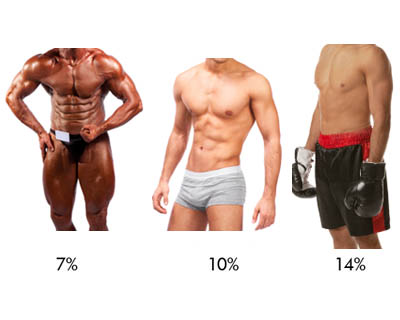 |
| Males at lower ranges of body fat where definition becomes visible. |
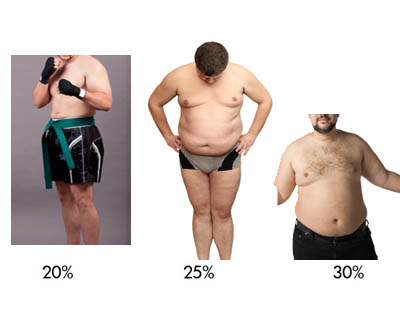 |
| After 30%, measuring body fat becomes difficult and is not a good metric of progress. |
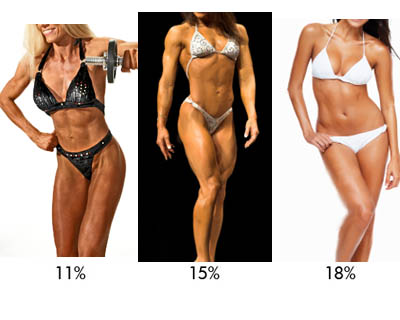 |
Females at lower ranges of body fat where definition becomes visible.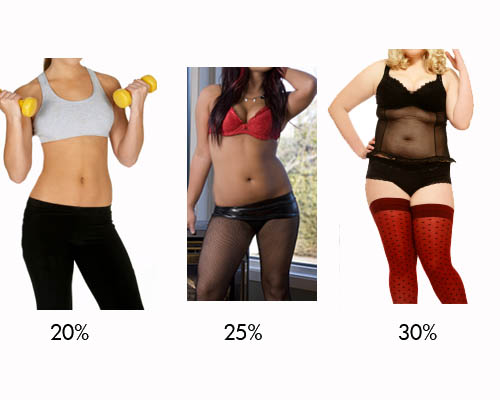 After 30%, measuring body fat becomes difficult and is not a good metric of progress. |
Where you lose body fat from first is determined by genetics and hormones. You cannot 'spot reduce' any area on your body by doing specific exercises, but you might be able to alter where you store fat through diet and exercise. Strength training and eating a diet low in refined carbohydrates will shift your hormonal profile and mobilize fat. Whether or not you can control where the fat is mobilized is up to debate. However, loosely subscribing to the idea that you can control your hormones and where you store fat may empower you. Instead of doing extra crunches to get rid of your stomach fat, you might try lowering the amount of sugar you eat to regulate your insulin response. This strategy will work to reduce overall fat, even if the fat-hormone connection is bogus. Here is a simple chart that expands on fat storage and hormone levels:

Muscle mass is another huger player in the specifics of how certain body fat percentages will look on certain people. These pictures illustrate:
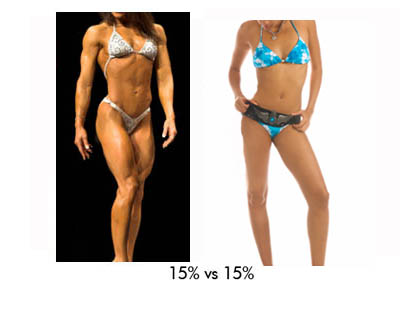 |
| These women have roughly the same body fat. |
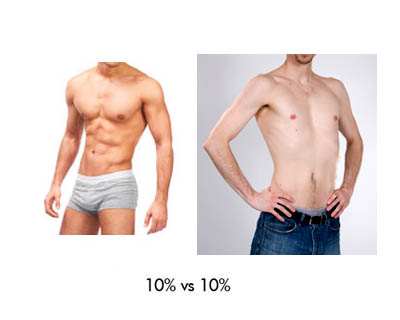 |
| These men have roughly the same body fat. |
Knowing your body fat percentage is a great tool if you feel like you have a couple of pounds to lose, or if you don't want to change your size, but you want to change your shape. If you have a lot of weight to lose or gain, weighing yourself might be relevant to your goals.
In the end, how you feel and how you feel about how you look is most important. If you're 8% body fat and feel like crap, you might need to hang out around a higher percentage. Setting body fat goals should not be another case of number chasing, it should be a way to quantify physical and aesthetic goals. If you realize the body of your dreams exists at a higher or lower percentage than you expected, throw caution to the numbers and go after that dream.
